


An illustrative scenario, not a client.
A distribution business signs a new trade customer on a Tuesday. Sales closes the deal in the CRM. Finance needs a credit check and an account in the accounting system. The warehouse needs delivery addresses and the agreed price list. Customer service needs the contacts.
Nobody owns the gap between these steps, so the sales coordinator becomes the integration. She re-keys the details three times, chases the credit decision by email, and remembers that this type of customer needs a signed pallet agreement before the first order ships, because that rule lives in her head. The first order arrives on Friday. It sits on stop, because the credit limit was never entered.
When operators see this pattern, two instincts follow. Replace the systems, or add another tool. Both are reasonable. Both usually make the problem more expensive.
Instinct one: replace the stack
The appeal is obvious: one system, one source of truth. The record is less kind. Panorama Consulting's 2026 ERP Report, a survey of 170 organisations, found that more than a quarter went over budget, most often because of "the unexpected need for additional technology". Its 2025 edition also documents the costs involved.
The tail is worse. Birmingham City Council began replacing a working SAP system with Oracle Fusion in October 2019. Go-live was planned for December 2020 and February 2021. It went live in April 2022, after which the council could not produce auditable accounts. By January 2026 the forecast cost had risen more than sevenfold, according to The Register. Its external auditor, Grant Thornton, pointed to poor governance, a lack of ownership among senior officers and a failure to stick to the plan to adopt standard processes.
A council is far bigger than a 120-person distributor, and the lesson transfers anyway. A new core system inherits every undocumented rule and messy handoff of the old one, and rediscovers them at go-live.
Instinct two: add another tool
The other route is gradual. A tool for every department, then an automation for every gap. Zylo's 2026 SaaS Management Index puts the average organisation at 305 applications. MuleSoft's 2025 Connectivity Benchmark Report, a survey of 1,050 IT leaders at large firms, found that only 29% of applications were connected and just 2% of organisations had integrated more than half of theirs. IT teams spent 39% of their time building custom integrations.
There is no equivalent survey for a 100-person firm, but the shape is familiar. Each trigger-based automation is small and sensible. Together they form a chain nobody has drawn. Rename a field in one app and a step fails quietly, and someone notices weeks later. Bots that copy a person's clicks have a poor record too: in its 2016 paper "Get ready for robots", EY wrote that it had seen as many as 30 to 50% of initial RPA projects fail.
The third option: keep the records, add a layer
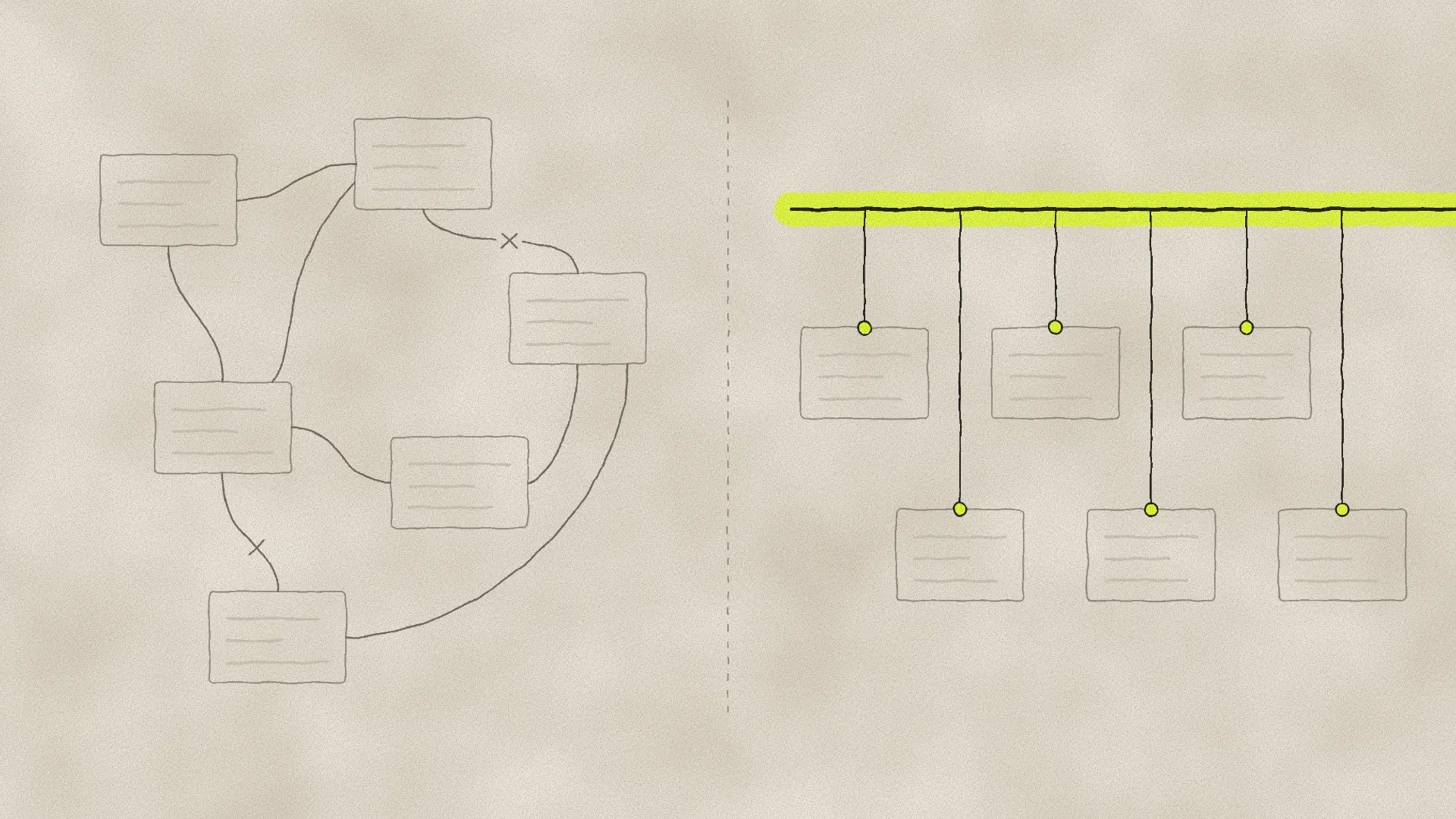
The shift we argue for keeps your systems of record and adds an operating layer across them. Here is what that means on a Tuesday afternoon.
- Existing systems remain where they make sense. The accounting system keeps the ledger and the CRM keeps the pipeline. Replacement becomes a decision made on evidence, one system at a time.
- An intelligent layer connects their context. It can read the customer record, the contract, the credit policy and the email thread together, the way your coordinator does today.
- Workflows span applications. "New customer" becomes one workflow with one owner, from signed contract to first delivery.
- AI handles interpretation where appropriate. Reading payment terms from a contract PDF, matching a trading name to a registered company, recognising a customer that needs a pallet agreement.
- Automation handles repeatability. Creating the account and loading the price list are fixed rules, so they run as ordinary automation, including tools like Zapier or n8n where a fixed rule is enough.
- Humans handle judgement. A credit limit above the threshold goes to the finance lead with the evidence assembled, and she approves or amends it.
- Actions and decisions remain observable. Every step is logged: what was read, what was proposed, who approved and what changed in which system.
One workflow, before and after
| Step | Before | After | |---|---|---| | Customer details | Re-keyed into three systems | Entered once, written to each system by the layer | | Credit check | Chased by email, decided in an inbox | Evidence assembled, routed to the finance lead, approval recorded | | Pallet agreement rule | Remembered by one person | Written into the workflow spec and tested | | Status | Known when someone asks | Visible to sales, finance and the warehouse | | When something fails | Found on Friday by the customer | Flagged at the step that failed, with a named owner |
Why the layer is practical now
Two things changed. Language models can now interpret messy inputs, which The Thesis covers. And the way AI connects to business systems is standardising. Anthropic released the Model Context Protocol (MCP), an open standard for connecting AI applications to business systems, in November 2024. OpenAI adopted it in March 2025. In December 2025 Anthropic donated MCP to the Agentic AI Foundation under the Linux Foundation, co-founded with Block and OpenAI and supported by Google, Microsoft and AWS.
In plain terms, a connection built to an open standard belongs to nobody's product roadmap. You can change the AI model later without rebuilding how it reaches your systems, which matters if your worry is lock-in. Whether an agent gets the answer right is a separate question, and the controls around it decide that.
Observability is the part that matters most
In the old model, the important decisions happen outside the systems: in inboxes, on calls, in someone's memory. The layer turns them into recorded decisions, with the evidence, the approver and the outcome attached.
This is also where agent projects fail. In June 2025 Gartner predicted that over 40% of agentic AI projects will be cancelled by the end of 2027, citing "escalating costs, unclear business value or inadequate risk controls". In May 2026 it added that 40% of enterprises will demote or decommission autonomous agents by 2027, because of governance gaps found only after production incidents. These are forecasts, and they point the same way.
Every build we ship includes the Control Plane: approvals, permissions, audit logs, escalation and rollback, with tests for the edge cases. Once a decision is logged, the rule behind it can be written down, checked and improved.
Returns come from redesign
McKinsey's State of AI 2025 found that 109 of its 1,993 respondents, about 6%, qualify as AI high performers, meaning they attribute 5% or more of EBIT to AI. Of those, 55% had fundamentally redesigned workflows, against 20% of everyone else. MIT's Project NANDA, in a preliminary 2025 report, found that 95% of the organisations it studied saw no measurable return from generative AI, and traced the gap to tools that do not learn or fit the workflow.
UK data shows the same shallowness. The Office for National Statistics reported in July 2026 that AI use among UK businesses with 10 or more employees rose from around 12% to around 35% since late 2023. Yet the average adopter uses 1.6 AI technologies, and only 10% of adopters use AI extensively.
Economists Erik Brynjolfsson, Daniel Rock and Chad Syverson call this the productivity J-curve: general purpose technologies need complementary, often invisible, investment before the gains show up. For a mid-sized firm, that investment is a clear account of how work actually flows.
The map comes before the machine
That is why we start with a map. Before anything is built, we document the systems, people, decisions and handoffs, including the exceptions and the rules nobody wrote down. We call it the Workflow Map.
The map is also why we prefer building capacity to running one-off projects. Once the systems are connected, the rules documented and the approval points designed, each new workflow reuses what the last one built. Context compounds, so the fifth workflow should cost less than the first.
If your coordinators are still the connective tissue between your systems, start by seeing the whole picture. The Floor Scan maps your workflows in a fixed scope, so your next decision is made on evidence.
Sources
- Panorama Consulting Group, *The 2026 ERP Report*, 2026.
- Panorama Consulting Group, *The 2025 ERP Report*, 2025.
- The Register, Birmingham City Council's Oracle ERP fiasco, 29 January 2026.
- The Register, Failure to act on Oracle rollout crashed Birmingham finances, 27 February 2025.
- Zylo, SaaS statistics from the 2026 SaaS Management Index.
- Salesforce and MuleSoft, 2025 Connectivity Benchmark Report announcement, 29 January 2025.
- Pega, The 3 critical mistakes of RPA, citing EY, Get ready for robots, 2016.
- TechCrunch, OpenAI adopts rival Anthropic's standard for connecting AI models to data, 26 March 2025.
- Model Context Protocol blog, MCP joins the Agentic AI Foundation, 9 December 2025.
- Gartner, Gartner Predicts Over 40% of Agentic AI Projects Will Be Canceled by End of 2027, 25 June 2025.
- Gartner, Gartner Says Applying Uniform Governance Across AI Agents Will Lead to Enterprise AI Agent Failure, 26 May 2026.
- McKinsey & Company, *The state of AI in 2025: Agents, innovation, and transformation*, November 2025.
- DX, summary of MIT Project NANDA, *The GenAI Divide: State of AI in Business 2025*.
- Office for National Statistics, Artificial intelligence in UK businesses: 2023 to 2026, 20 July 2026.
- Erik Brynjolfsson, Daniel Rock and Chad Syverson, The Productivity J-Curve: How Intangibles Complement General Purpose Technologies, American Economic Journal: Macroeconomics 13(1), 2021.