

A supplier emails your accounts inbox at 10:14 on a Tuesday. Invoice 4471 was paid £1,860 short, and they would like to know why.
Someone in finance picks it up. They find the supplier in the accounting system and the purchase order in the ERP. The delivery note is a scanned PDF on a shared drive, and it shows one pallet where the invoice bills for two, so they message the warehouse. The answer comes back after lunch: the second pallet arrived, but it was booked against a different order. They move the receipt to the right order, release the balance for payment, add a note to the supplier record, reply to the supplier and let the buyer know what happened.
One query touched five systems and took the best part of a day. Nothing broke along the way. Every system held its piece of the answer exactly as designed, and the only thing joining those pieces up was a person.
Software arrived one department at a time
Finance got an accounting package, then an ERP. Sales got a CRM. Support got a helpdesk, HR got an HR system, marketing got an automation platform, and operations got a project tool and a great many spreadsheets. Each purchase made sense to the team that made it, and each system is judged on how well it does that team's job.
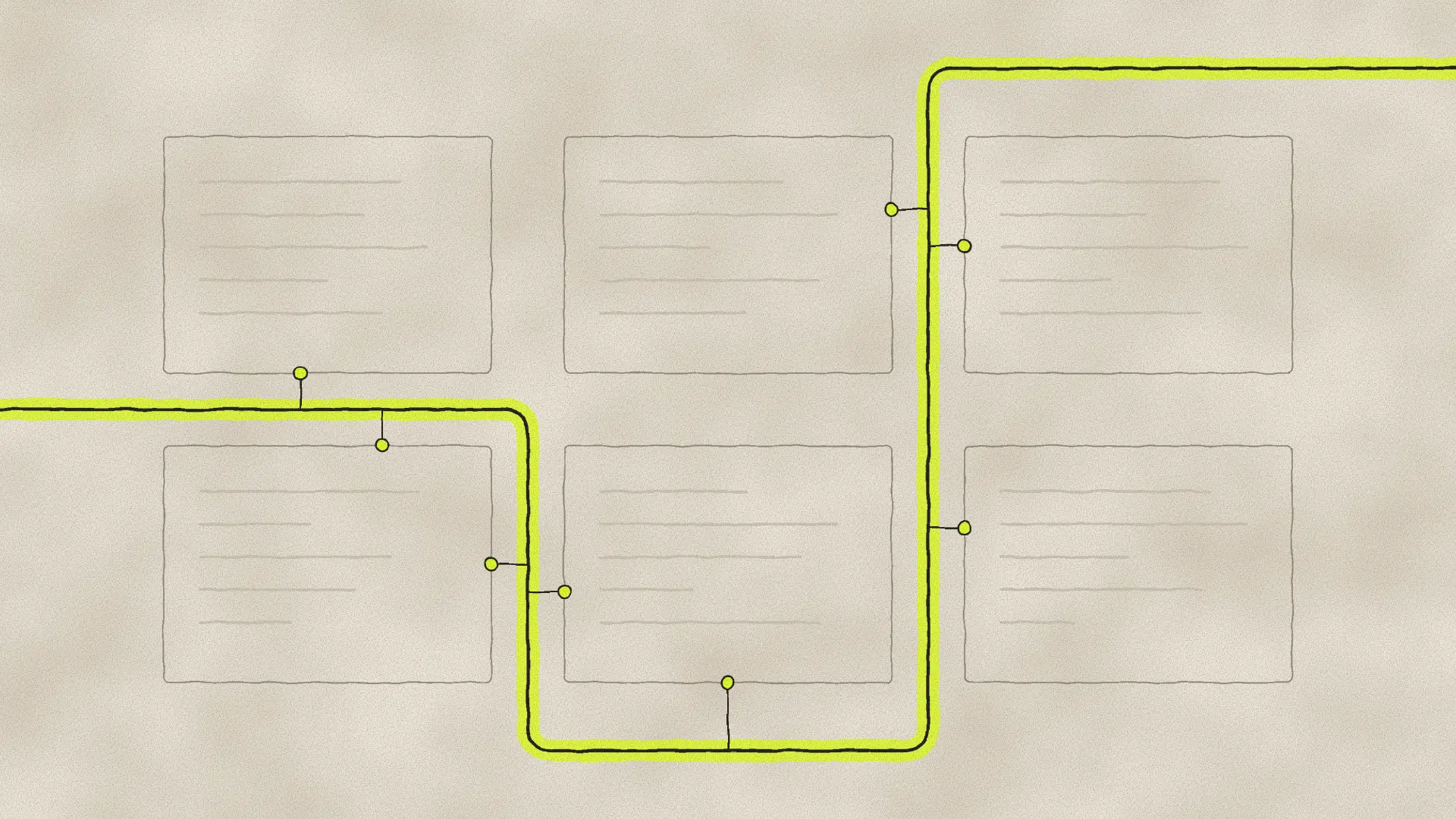
Nobody bought the flow between them. A supplier query, a new customer or the Monday management pack crosses several of those systems, and none of them owns the whole journey. Gartner analyst Tori Paulman told Axios in 2022 that workers use six to eight apps, on average, to complete a single business process. The work between those apps falls to people, who read in one place, check in another, copy into a third and chase someone in a fourth. IT teams call this swivel-chair integration. We call the person in the chair human middleware.
A 2022 Harvard Business Review study tracked 137 people at three Fortune 500 companies, most of them in mid- and back-office teams such as finance, HR and supply chain. They switched between apps and websites roughly 1,200 times a day. Getting their bearings after each switch cost them just under four hours a week, about 9% of their working year. The researchers wrote that a sizeable part of these jobs is acting as "the glue between disparate applications".
Why the gaps stayed manual
Tools for connecting systems have been around for more than twenty years. Integration platforms and tools like Zapier and n8n sync records and fire an action when a trigger lands. Robotic process automation clicks through screens the way a person would. All of them need the rule fixed in advance: when a deal closes in the CRM, create the customer in the accounting system, the same way every time.
The work between systems rarely looks like that. Go back to the short payment. Which order does the email refer to? Is a missing pallet a delivery problem or a booking error? Each answer takes a small act of interpretation, and fixed-rule tools break on interpretation. So the judgment stayed with people, and the copying, checking, chasing and reconciling around it stayed with them too. For a business of 80 or 200 people, another coordinator was cheaper than engineering around every exception.
What changed
Language models can do the part those tools could not. A model can read the supplier's email and work out which invoice it means. It can pull the purchase order, read the scanned delivery note, spot that the quantities disagree and draft the question for the warehouse. Traditional automation moved data. Models can increasingly interpret it, and that brings the step which kept these processes manual within reach of a system for the first time.
There is a limit, and it has little to do with how capable the models are. An agent can read a chaotic invoice. It cannot guess an approval rule nobody wrote down. If the only record of why one supplier always gets paid early lives in one person's head, no model will find it. Someone has to surface that rule and write it down before any agent can follow it.
The wrong place to put the AI
If your company has an AI plan, there is a fair chance it reads like this. Switch on the assistant in each tool we already pay for, then see what happens. It is an easy plan to approve. Your CRM has an agent now, and so does your helpdesk.
Those assistants are useful inside their own walls. Each one is built around its vendor's product. It knows that system's data well and sees everything else through whichever connectors the vendor chose to build. Switch on six of them, and you get six faster departments, while the supplier query still travels from inbox to ERP to warehouse chat and back on one person's shoulders. That person now has six assistants to check as well.
The expensive work in most businesses sits in the handoffs, and a handoff belongs to no single vendor. Making each box faster leaves the work between the boxes where it was.
We have been here before
In July 1987, the economist Robert Solow wrote that "you can see the computer age everywhere but in the productivity statistics." Three years later, the economic historian Paul David offered an explanation by looking back at electricity.
In 1899, electric motors supplied less than 5% of the power driving machinery in American factories. A steam-era factory ran off one large engine turning a line shaft, with belts dropping to each machine, so the building was laid out around the shaft. Early electrification mostly bolted motors onto that arrangement and left the layout alone.
The payoff came in the 1920s, once factories gave each machine its own motor and rebuilt the floor around the flow of materials, in lighter, single-storey buildings. In American manufacturing, productivity measured against all inputs had grown at under 1% a year for some three decades. Between 1919 and 1929 it grew at more than 5% a year, according to David and Gavin Wright. Electric power had been available since the 1880s. The gain arrived when the work was redesigned around it.
An assistant inside each tool is a new motor on the old shaft.
Our thesis
Enterprise systems digitised the functions. AI can connect the flow. The next big gain in productivity will come from automating the work between them.
In practice, that means a layer across the systems you already run. Your CRM, ERP and helpdesk stay where they are. Agents take on the work between them: reading what arrives, gathering the context a person would otherwise hunt for, deciding within rules you set and acting in your systems.
Run the supplier query through it. An agent reads the email, matches the invoice, pulls the purchase order and delivery note, then checks recent goods receipts and finds the second pallet booked against another order. It drafts the correction and the reply, and a person approves the payment because money is leaving the business. Had it found nothing, finance would get the case with the evidence already assembled. Either way, a person still makes the call. They just stop being the cable between five systems.
Most of the design work is deciding where people belong. Agents act alone only where a task is safe and repeatable, and a person approves anything with real consequences. Every action leaves an audit trail, and anything the agent is unsure about goes to a human. Each system we build ships with those controls, plus a living spec, the business rules in writing, tests and runbooks, so your own team can run it without us. We call that set the Control Plane.
Where to start
Start with the work, before any technology. Pick one process that crosses several systems and runs often, such as approving supplier invoices or assembling the Monday management pack. Follow a single case from the moment it arrives to the moment it is finished. Write down every time someone copies, searches, checks, updates or chases, and every decision along the way, especially the ones only one person knows how to make.
You will end up with a map of where your people are acting as middleware. It will also show which handoffs to automate, which to augment and which to leave with people. Favour frequency over sophistication. A dull handoff that happens 300 times a month is worth more than a clever one that happens twice.
If you would rather have that map drawn for you, start with an Assessment: a fixed-scope review of your highest-value workflows that stays useful whether or not we build anything afterwards.
Sources
- Robert M. Solow, "We'd Better Watch Out", New York Times Book Review, 12 July 1987, p. 36.
- Paul A. David, "The Dynamo and the Computer: An Historical Perspective on the Modern Productivity Paradox", American Economic Review 80(2), May 1990, pp. 355-361.
- Paul A. David and Gavin Wright, "General Purpose Technologies and Surges in Productivity: Historical Reflections on the Future of the ICT Revolution", University of Oxford Discussion Papers in Economic and Social History, No. 31, 1999.
- Rohan Narayana Murty, Sandeep Dadlani and Rajath B. Das, "How Much Time and Energy Do We Waste Toggling Between Applications?", Harvard Business Review, 29 August 2022.
- Axios, "How tech can make work harder", 7 November 2022, quoting Tori Paulman of Gartner.