


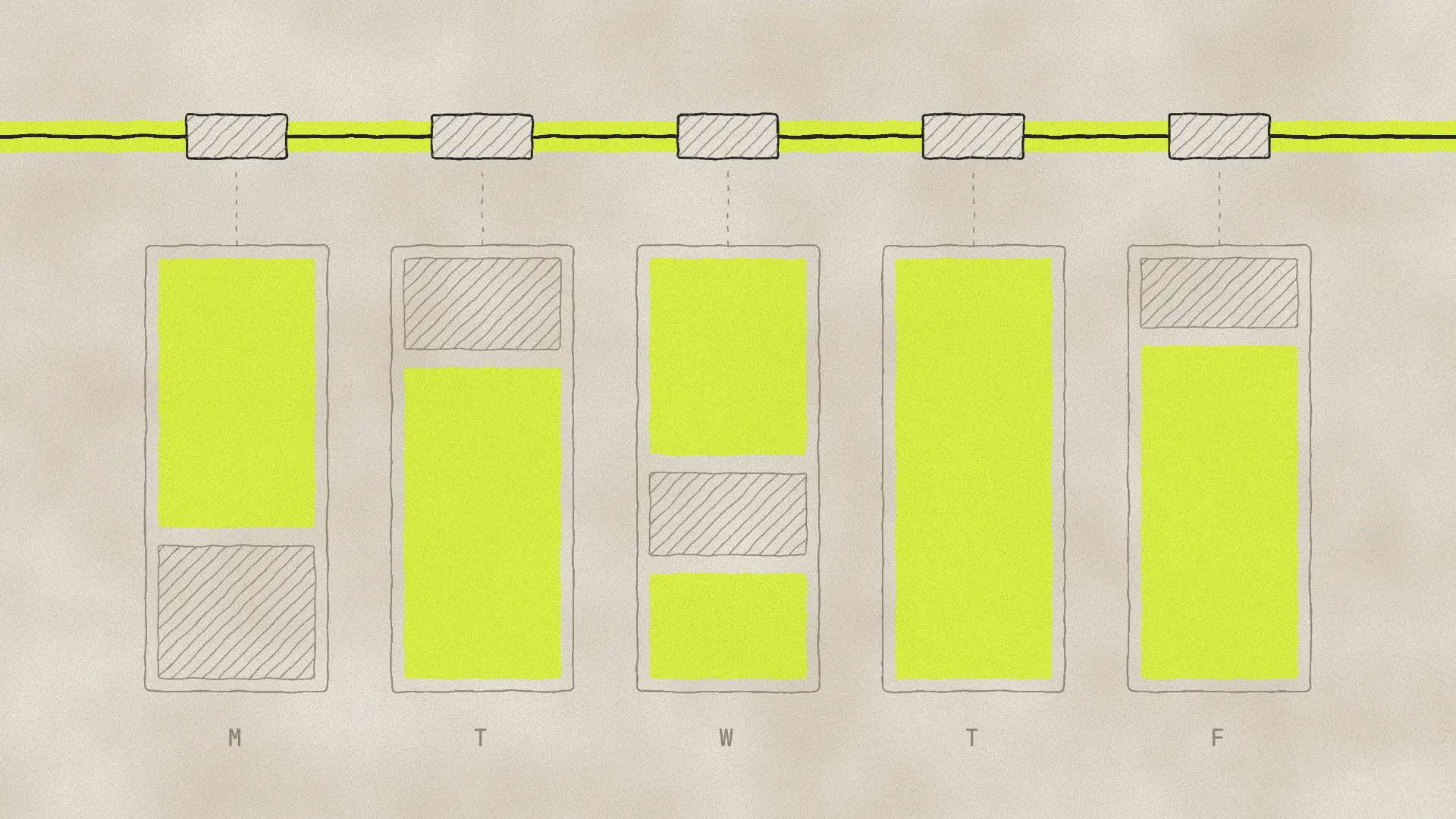
One person's week
An illustrative week, built from patterns common in mid-sized firms. Priya is not a client.
Priya was hired to manage suppliers. Her job description talks about negotiation, supplier performance and cost.
On Monday she reconciles purchase orders between the ERP and the spreadsheet the warehouse team trusts more. Two suppliers have changed pack sizes, so the numbers disagree. She fixes them by hand, because she knows which system is wrong this month.
Tuesday goes on approvals. A price change needs sign-off from finance, so she chases it in Slack, then by email, then at someone's desk. Wednesday is exceptions.
On Thursday afternoon she finally negotiates. It is the part of the job she is best at, and it gets what is left of the week.
The principle
Don't automate people. Automate the work they should never have been doing.
Put plainly: Scapebridge removes unnecessary coordination from human work and keeps the people. The aim is fewer hours spent carrying information between systems, with the same team doing more of the work it was hired for. If a board or a peer has asked you how many roles AI can remove, this is our answer. The rest of this piece is the commercial case for it.
What people are for
People are good at judgment, relationships, creativity, negotiation, leadership and ambiguity. Companies should use them there.
Take two of those. In an operating week, negotiation looks like Priya noticing that a supplier's lead times have slipped three times this quarter and using it to reopen terms before renewal. Judgment looks like a finance lead deciding that a late invoice from a long-standing supplier gets paid this week, while a new supplier's invoice waits for a proper check.
Both need time and attention, and coordination work takes both first, because it is urgent and somebody is waiting. Negotiation can always move to Thursday. The reconciliation cannot. So the work people do best gets the leftovers.
The middleware job
The line continues: not as middleware between Salesforce, Excel, Slack and an inbox.
That is still where many capable people spend their days. They carry information from one system to another. They remember the exceptions: the customer whose orders always need a manual credit check, the supplier who invoices in two parts. They know who needs to be asked, and who is on holiday this week. Very little of it is written down.
The job stays invisible until it stops. When the person who remembers the exceptions leaves, the process leaves with them. In a 2018 survey of 1,001 US workers run with YouGov, Panopto found that 42% of the knowledge people use in their role is unique to them.
Why the headcount-first business case fails
Coordination work arrives in slices: twenty minutes of reconciling here, an hour of chasing approvals there, spread across operations, finance, sales and customer service. When the McKinsey Global Institute analysed more than 2,000 work activities across 800 occupations, it found fewer than 5% of occupations could be fully automated with demonstrated technology, while about 60% had at least 30% of their activities automatable. Removing a slice returns time. It seldom removes a whole job.
The people doing those slices also hold the rules. An agent can read a chaotic invoice, but it cannot guess an approval rule nobody wrote down. Cut the people before those rules are captured and the automation fails. In Orgvue's 2025 survey of senior leaders, 55% of those who had made staff redundant because of AI said they had got those decisions wrong. Klarna went back to recruiting human customer service agents in 2025, though its AI assistant still handled 80% of chats that year, according to its annual filing. Its chief executive told Bloomberg that cost had weighed too heavily and the result was "lower quality".
Fear also bends the map. In Microsoft and LinkedIn's 2024 Work Trend Index, 53% of people using AI at work worried it made them look replaceable. A team expecting cuts keeps its workarounds quiet, and you end up automating the process people describe instead of the one they run.
So price the problem in salary, because that is where the cost sits, and count the return as capacity moved to better work. In a Danish study of 25,000 workers, economists Anders Humlum and Emilie Vestergaard found that 80% of people who saved time with AI chatbots spent it on other job tasks.
How the principle shows up in a build
Each stage of our work is set up around it. Map looks for coordination work wherever it sits, across every role that touches a process, and the Assessment records the exceptions and hidden decision rules as a process map. Design decides where people judge and where an agent acts. Build puts approvals behind the Control Gate, with permissions, audit logs, escalation and rollback. Operate measures the hours returned and where they went, in a form a finance lead can check.
Humans stay in the loop because we designed the loop that way.
A test you can use
For any proposed automation, ask one question. Was this work the person was hired to do, or work they inherited because two systems don't talk? If it was inherited, automate it and keep the person. If it is the job, leave it with them and give them more time for it.
To see where that line falls across your business, map your process with an Assessment.
Sources
- Panopto with YouGov, Workplace Knowledge and Productivity Report, July 2018.
- McKinsey Global Institute, Four fundamentals of workplace automation and A Future That Works, 2016 to 2017.
- Orgvue, press release on AI redundancies, 29 April 2025.
- Klarna Group plc, annual report on Form 20-F for 2025, filed 26 February 2026.
- Fortune, "Klarna plans to hire humans again", 9 May 2025, quoting Bloomberg.
- Microsoft and LinkedIn, 2024 Work Trend Index, 8 May 2024.
- Anders Humlum and Emilie Vestergaard, Large Language Models, Small Labor Market Effects, NBER Working Paper 33777, May 2025.